
The Inquiro Framework sets out the intellectual structure that underpins professional open-source investigations conducted through Inquiro Intelligence.
It consists of three elements: the Inquiro Doctrine, which explains the philosophy of professional OSINT; the Inquiro Principles, which describe the analytical discipline investigators must apply; and the Inquiro Intelligence Model, which provides the structured methodology through which investigations are conducted.
The Inquiro Framework
A structured Methodology for Open-Source Investigations
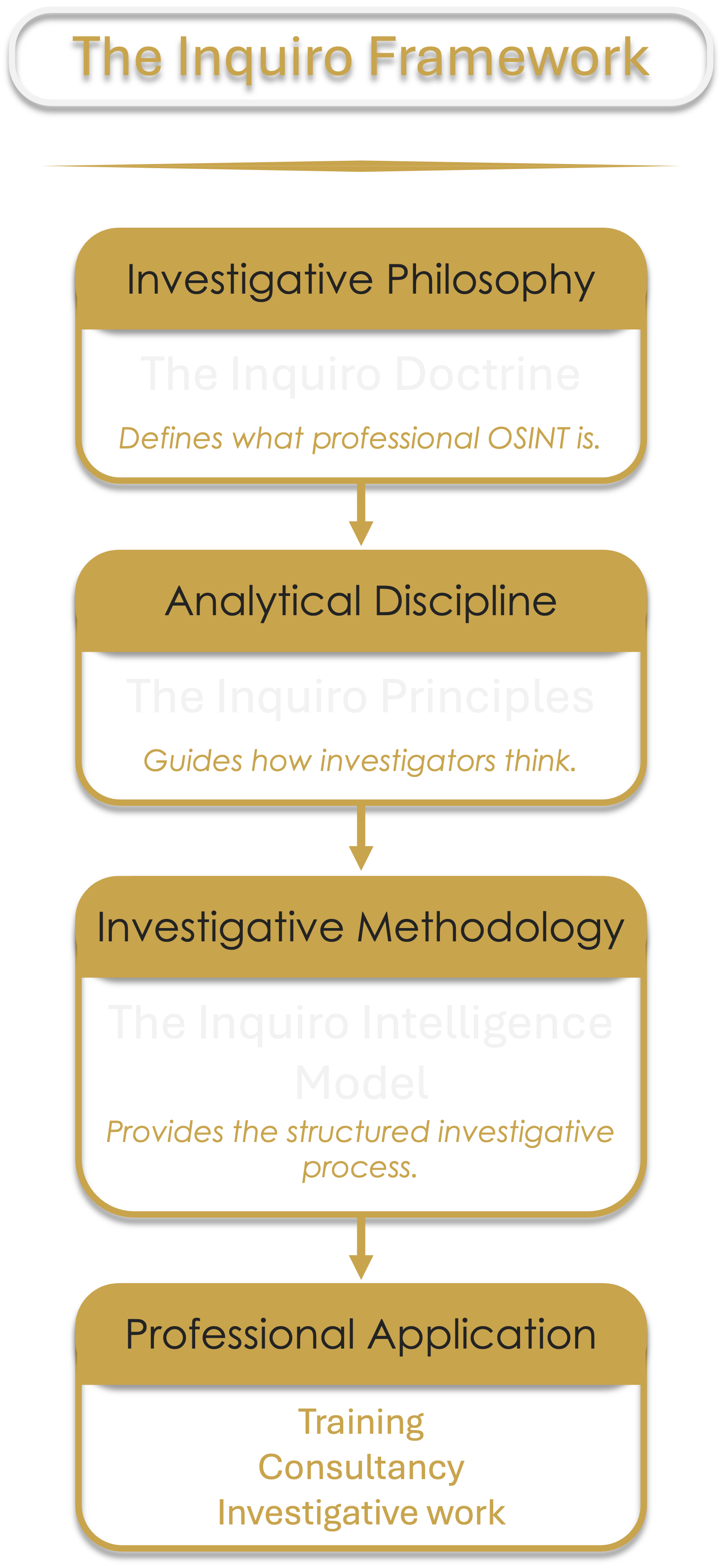
The Inquiro Doctrine
Open-source intelligence is not defined by the ability to find information, but by the discipline required to evaluate, interpret, and explain it.
The rapid expansion of publicly accessible information has transformed the investigative landscape. Vast quantities of data relating to individuals, organisations, and events are now available through websites, social media platforms, public records, and digital media.
The availability of information does not guarantee the presence of reliable understanding.
The modern information environment is shaped by incomplete reporting, algorithmic amplification, misinformation, disinformation, and manipulated digital media. In this environment, the ability to locate information online is no longer the primary challenge for investigators.
The central challenge is determining what information means, whether it can be trusted, and what conclusions can responsibly be drawn from it.
The Inquiro Doctrine sets out the principles that underpin professional open-source intelligence investigations.
These principles reflect the belief that OSINT should be conducted with the same discipline and methodological rigour as any other professional investigative practice.
The Inquiro Principles
Principle 1 - Intelligence Requires Methodology
Information discovered online becomes intelligence only when it has been evaluated through structured investigative methodology. Without methodological discipline, investigators risk drawing conclusions from incomplete, unreliable, or misleading information.
Professional OSINT therefore requires clear investigative processes that guide research from initial question to defensible conclusion.
Principle 2 - Tools Support Investigation - They Do Not Replace It
Technical tools can assist investigators in locating information, but they do not produce understanding. Professional OSINT depends on investigative tradecraft: the ability to define investigative questions, evaluate sources critically, and interpret information responsibly.
Tools evolve rapidly.
Methodology endures.
Principle 3 - Verification Is Continuous
In an information environment influenced by misinformation and manipulated media, verification cannot be treated as a single stage of investigation.
Verification must accompany every stage of analysis.
Investigators must continually assess the origin, reliability, and context of the information they encounter.
Principle 4 - Context Determines Meaning
Information rarely speaks for itself.
Images, digital records, and social media content may appear meaningful when viewed in isolation but can take on very different interpretations when placed within their proper context. Professional investigators must therefore reconstruct the circumstances in which information was created, shared, and interpreted.
Principle 5 - Investigative Thinking Matters More Than Information Access
The internet provides unprecedented access to information, but access alone does not produce insight. Professional OSINT requires analytical reasoning, intellectual discipline, and the ability to recognise uncertainty and alternative explanations.
Investigators must remain cautious about drawing conclusions based solely on the presence of information.
Principle 6 - Reliable Intelligence Must Withstand Scrutiny
Open-source investigations may influence operational decisions, legal proceedings, and reputational outcomes. For this reason, intelligence derived from open sources must be transparent, methodologically sound, and capable of withstanding challenge.
The credibility of intelligence depends not only on the conclusions reached but on the discipline of the process used to reach them.
The Inquiro Intelligence Model
The Inquiro Intelligence Model is a structured investigative framework that transforms publicly available information into reliable intelligence through disciplined methodology and continuous analytical evaluation.
The Principles set out in the Inquiro Doctrine are operationalised through the Inquiro Intelligence Model, a structured investigative methodology designed to guide professional open-source investigations.
The model provides the disciplined process through which investigators transform publicly available information into reliable intelligence.
Open-source investigations conducted without clear methodology risk producing conclusions based on incomplete or misleading information.
The Inquiro Intelligence Model ensures that investigative work follows a systematic process capable of producing transparent and defensible analytical conclusions.
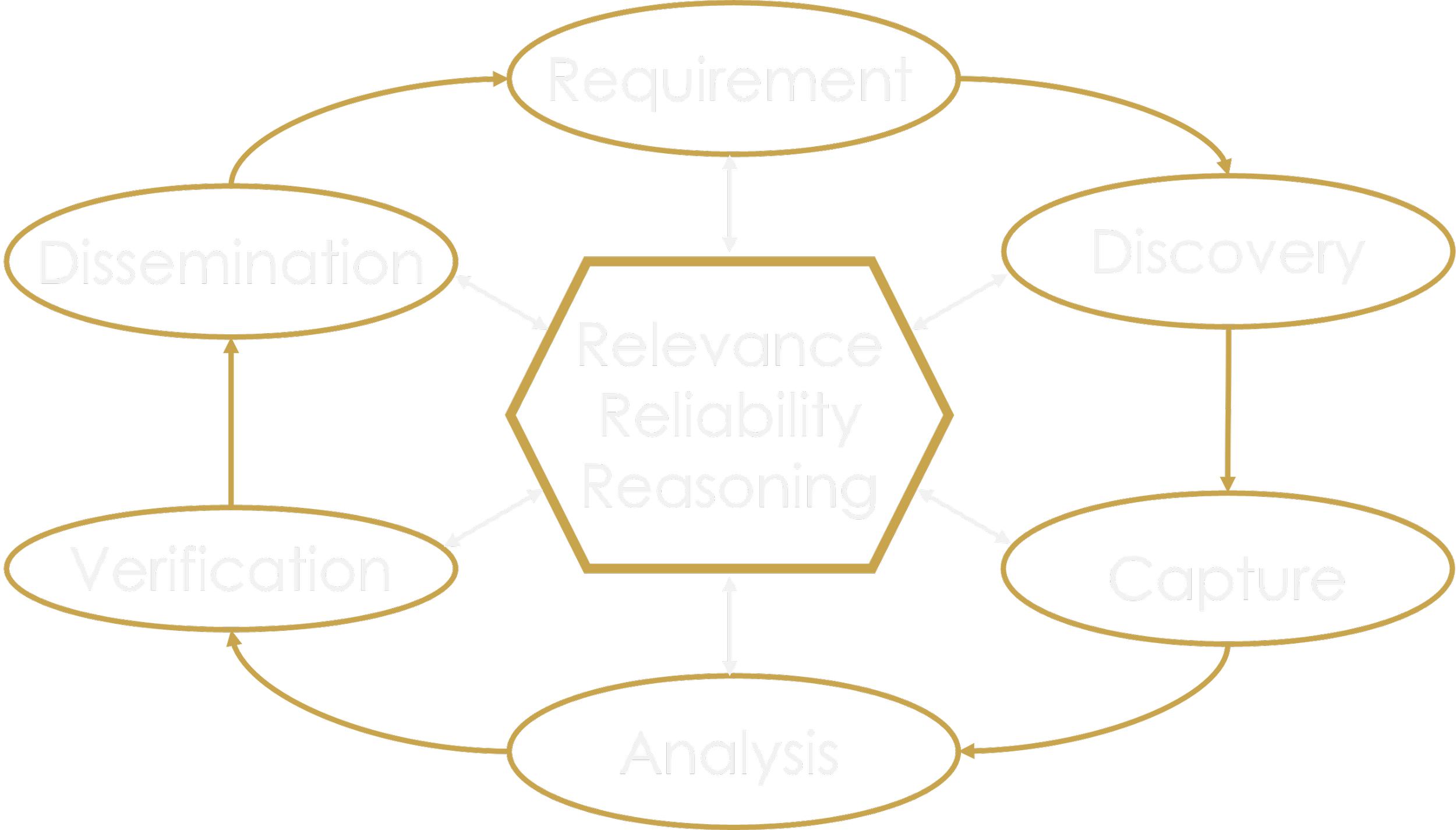
The model guides investigations through six stages.
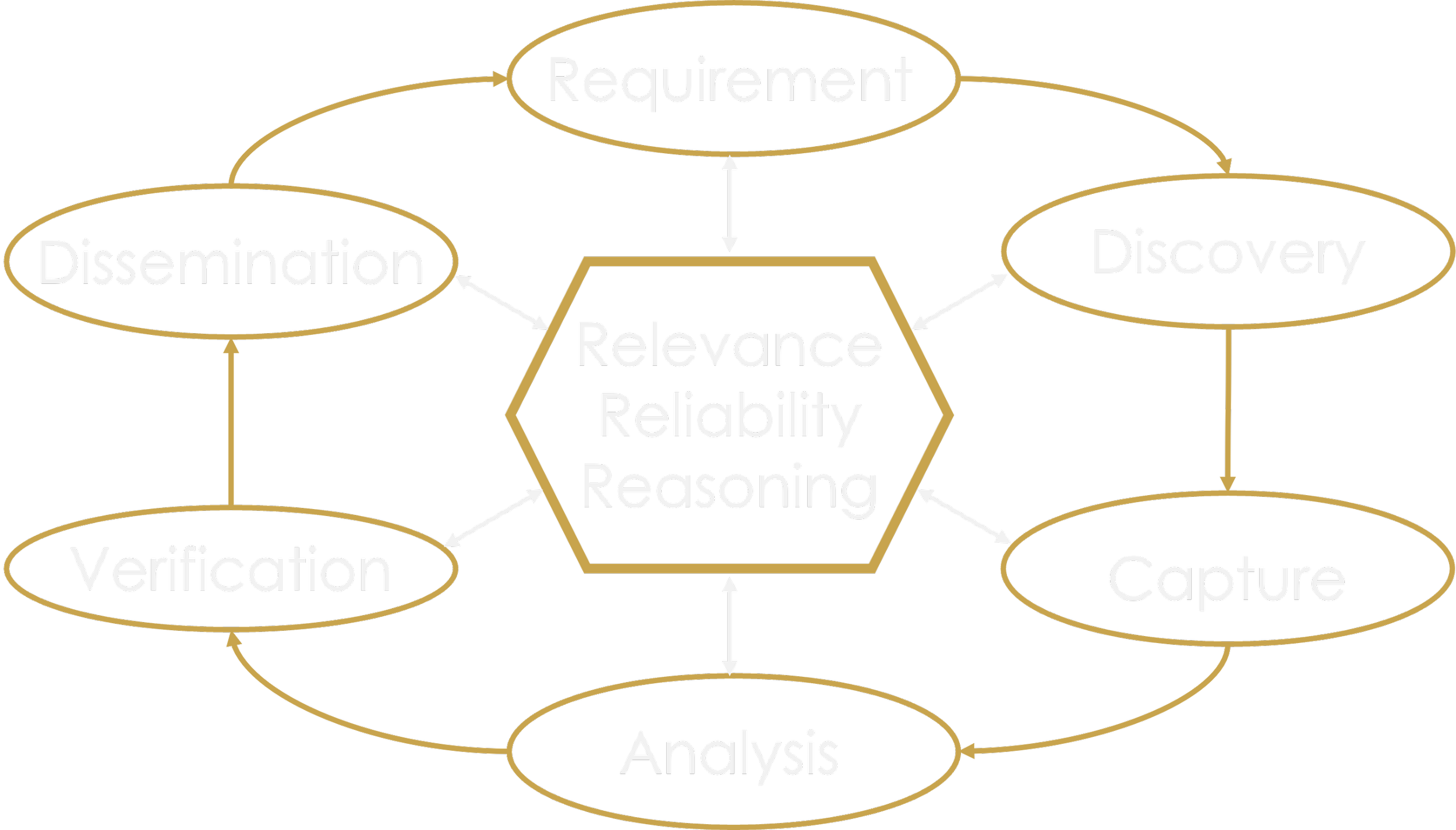
Requirement
Every investigation begins with a clearly defined intelligence requirement.
This stage establishes the question being asked, the decision that the research will inform, and the scope of the investigation.
Poorly defined investigative questions often lead to unfocused research and misleading conclusions. Defining the requirement ensures that investigative effort remains aligned with the problem that needs to be solved.
Discovery
Discovery involves the systematic identification of potential sources of relevant information. Investigators identify where relevant information may exist and how it may be located. This stage focuses on mapping the information environment surrounding the investigative question.
The objective is not to gather the largest possible volume of information, but to identify sources that are most likely to provide meaningful insight.
Capture
Information identified during research must be preserved in a way that maintains its evidential integrity. This includes recording the original source of information, capturing content accurately, and documenting when and where the material was discovered.
Maintaining provenance is essential for ensuring that investigative findings can be explained, verified, and supported if challenged.
Analysis
Analysis involves interpreting the information that has been collected. Investigators examine the material in order to identify patterns, relationships, or explanations that address the original investigative question.
This stage requires disciplined analytical thinking. Investigators must distinguish between evidence, inference, and speculation while remaining aware of potential bias or alternative explanations.
Verification
Verification tests the reliability of the information that has been collected and analysed.
This may involve confirming the authenticity of sources, identifying manipulated or misleading content, and cross-referencing information with independent sources.
In an information environment influenced by misinformation and disinformation, verification is a critical stage in ensuring that investigative conclusions are based on credible evidence.
Dissemination
The final stage involves communicating investigative findings clearly and responsibly.
Intelligence must be presented in a way that explains the conclusions reached, the evidence supporting those conclusions, and any limitations or uncertainties that remain.
Continuous Analytical Tests
Throughout every stage of the investigative process, investigators apply three continuous analytical tests. These tests ensure that investigations remain disciplined and focused.
Relevance
Does the information discovered directly relate to the investigative question?
Investigations often produce large quantities of material. The relevance test ensures that research remains focused on information that helps answer the original requirement.
Reliability
Can the information be trusted?
Investigators must consider the credibility of sources, the origin of information, and the possibility that content may be misleading or manipulated.
Reasoning
Are the conclusions supported by sound analytical judgement?
Investigators must consider alternative explanations, recognise potential bias, and ensure that conclusions follow logically from the evidence available.
A Structured Approach to Professional OSINT
The purpose of the Inquiro Intelligence Model is not simply to describe a theoretical framework. It ensures that professional OSINT investigations are conducted in a way that produces intelligence that is:
reliable
transparent
defensible
capable of supporting real-world decisions
In an information environment increasingly shaped by misinformation, disinformation, and digital manipulation, structured investigative methodology has become essential.
Applying the Model in Practice
The principles of the Inquiro Intelligence Model underpin the training and consultancy services delivered by Inquiro Intelligence. Through professional training programmes and specialist advisory services, organisations can develop the skills required to apply structured investigative methodology when working with open-source information.
Understanding information online requires more than locating it.
It requires the ability to evaluate sources critically, interpret evidence responsibly, and communicate findings clearly.
The Inquiro Intelligence Model provides the structured framework needed to ensure that open-source investigations produce intelligence that can be trusted.
Investigative Discipline in the Digital Information Environment
The expansion of publicly accessible information has created powerful opportunities for investigators and analysts. At the same time, it has introduced new challenges relating to the reliability and interpretation of digital information.
Professional open-source intelligence therefore requires more than technical skill. It requires investigative discipline, structured methodology, and analytical judgement.
The Inquiro Doctrine, the Inquiro Principles, and the Inquiro Intelligence Model together provide a framework for ensuring that open-source investigations are conducted with the rigour and responsibility required in the modern information environment.
Through this framework, investigators and organisations can apply a disciplined methodology for transforming publicly available information into reliable intelligence.